



July 13, 2026
For a hundred years, corporate expansion left footprints. A company entering a new market registered a subsidiary, signed a lease, filed with the local tax authority. Everyone whose job depends on spotting expansion — investment promotion agencies, economic developers, market-entry advisors, B2B sales teams — built their radar on those footprints.
That radar still works perfectly. It's just pointed at the wrong door.
Over the past five years, a growing share of cross-border market entry has moved to a channel that produces no entity, no lease, and no local filing: the Employer of Record. And the numbers behind that shift are bigger, and moving faster, than most people watching official statistics realize.
An Employer of Record legally employs workers on a company's behalf in countries where that company has no entity, handling contracts, payroll, benefits, and compliance while the client directs the actual work. A decade ago this was an obscure workaround. Today it's a standard operating model.
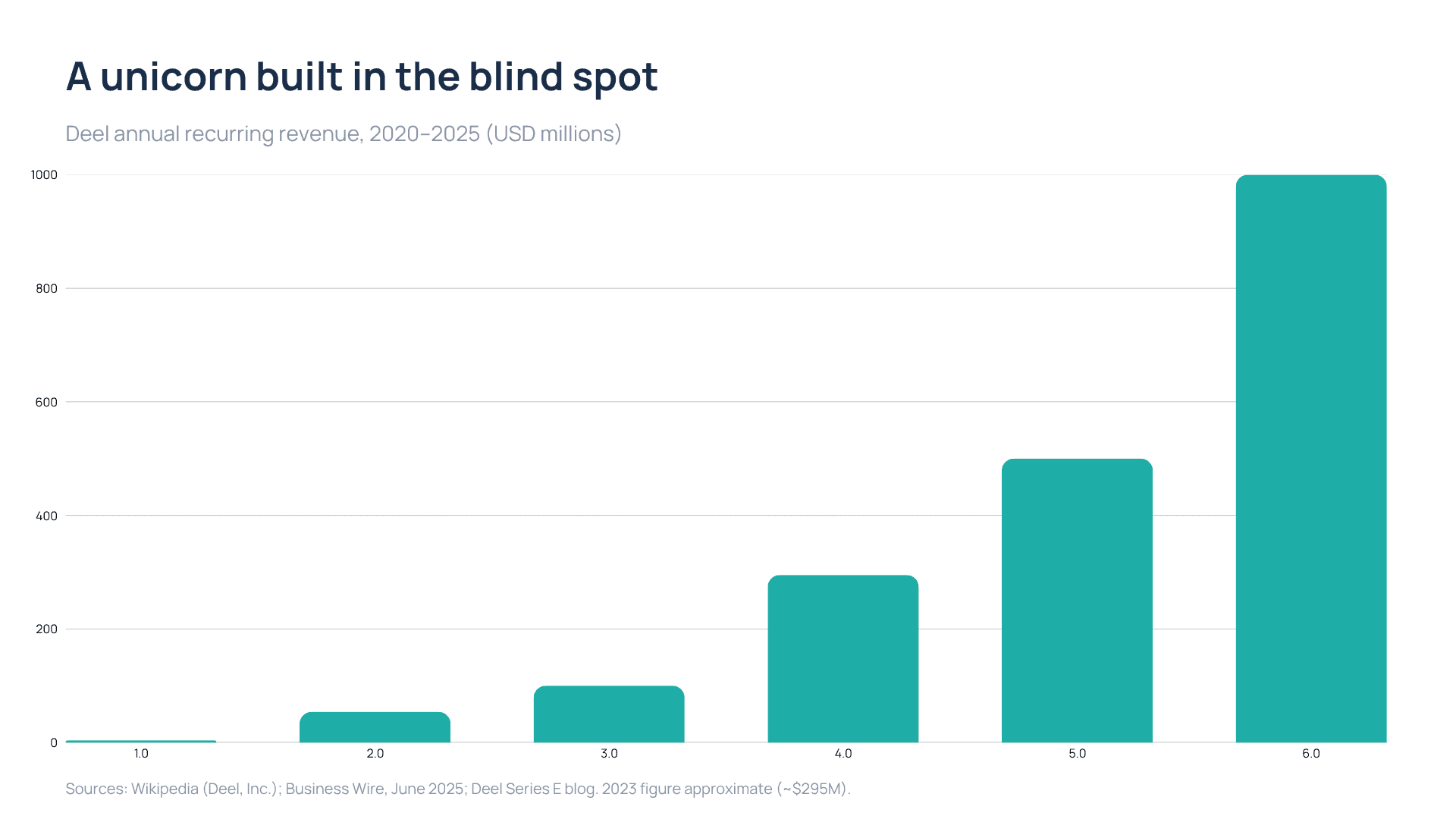
And Deel is one player. G-P (Globalization Partners) supports teams in 180+ countries. Remote, Papaya Global, Velocity Global, Oyster, and Multiplier collectively raised billions between 2020 and 2022. When Revolut — a $75 billion fintech — announced its own EOR product, the signal was unmistakable: this is infrastructure now, not a workaround.
Analyst forecasts put EOR service revenue at roughly $5–6 billion in 2025, heading toward $10–20 billion over the next decade depending on whose assumptions you believe. But the fee revenue understates the phenomenon by an order of magnitude: those fees are a thin layer on top of the actual employment. Deel alone processes $22 billion in payroll annually. That's the size of the economic activity flowing through just one provider's entity-less channel.
The shift isn't ideological but arithmetic.
Establishing a legal entity in a new country typically takes three to nine months and costs anywhere from $15,000 to over $100,000 upfront — before the first hire — plus substantial annual maintenance. An EOR gets a compliant employee working in days, for a few hundred dollars a month, with no long-term commitment. If the market doesn't work out, you offboard one person instead of winding down a subsidiary.
For any company testing a market, one sales hire in Germany, a two-person customer success team in Singapore, the entity route stopped making sense. The playbook that emerged instead: enter via EOR, validate demand with the first few hires, and only convert to an entity once the market has proven itself. Industry guides now describe the EOR-to-entity transition as a standard maturity path, sometimes years into a market presence.
And here's the part that should worry anyone whose job is to detect expansion: this isn't offshoring in disguise. Deel's own data across a million-plus worker contracts shows that top-funded startups are expanding internationally earlier in their lifecycle and hiring cross-border for specialized talent and market reach, not cost savings. Their hiring concentrates in wealthy markets like the UK, Canada, and Germany. When a venture-backed company puts a sales lead or a country manager on an EOR contract in Frankfurt, that is market entry by any commercial definition. It just doesn't look like it on paper, because there is no paper.
Put those pieces together and something fundamental has flipped.
Entity registration used to be a leading indicator of market entry: the filing came first, the hiring and selling came after. Today it's a lagging indicator of market commitment: companies routinely operate in a market for one to three years — hiring, selling, serving customers — before an entity appears. Many never register one at all.
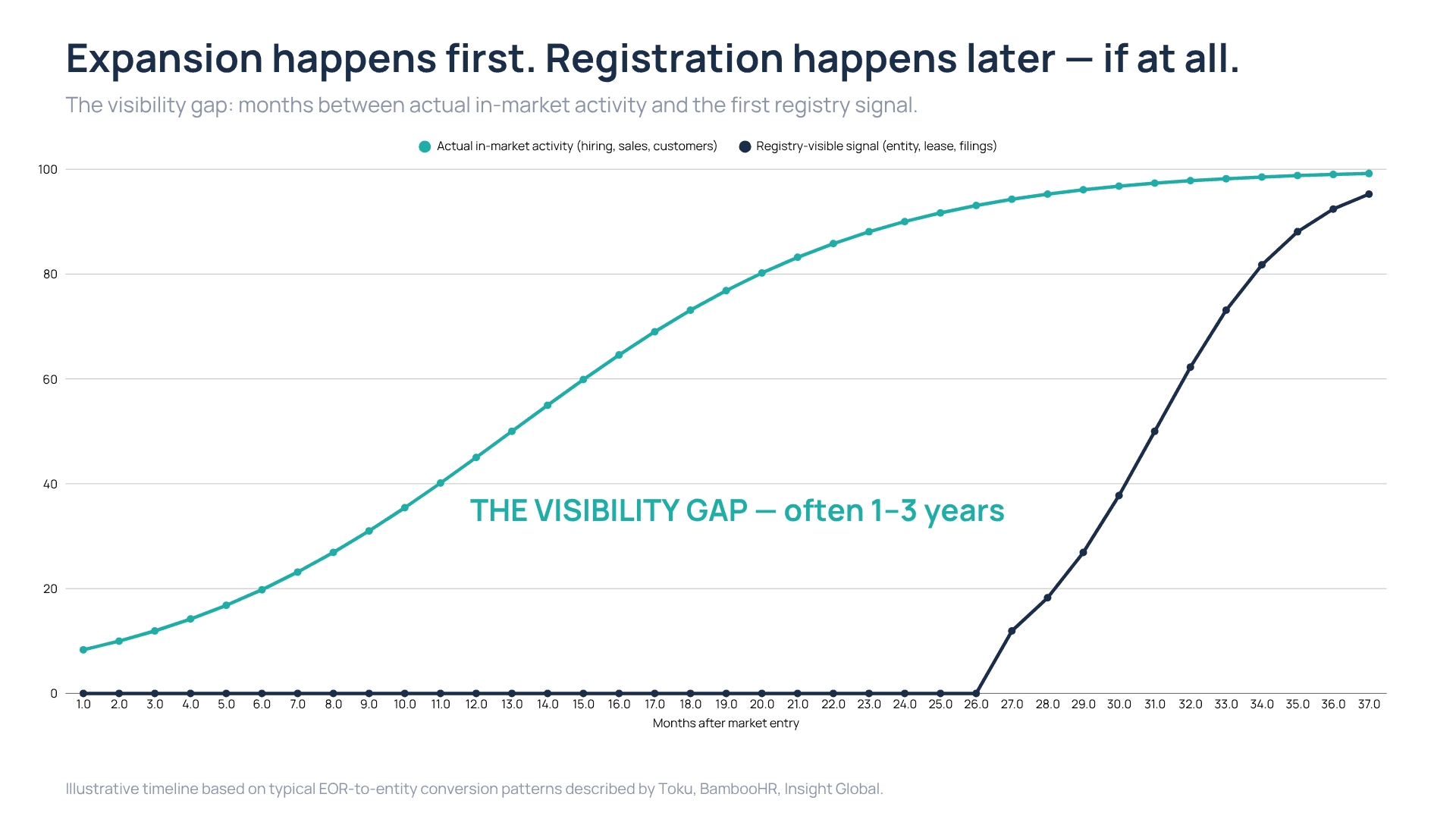
Everyone who relies on registries is now structurally late. By the time the subsidiary shows up in the commercial register, the company has chosen its advisors, its bank, its first office, its recruiting partners, and the investment promotion agency that would have loved to shape that decision never knew there was a decision to shape.
Even tax authorities have noticed. The growing enforcement focus on "permanent establishment" risk, where a single revenue-generating employee can trigger local tax obligations despite the absence of any entity, exists precisely because economic presence now routinely precedes legal presence. The regulators are chasing the same ghost the economic developers are.
The expansion didn't stop being detectable. It moved upstream.
The intent that used to show up as an entity filing now shows up earlier and elsewhere: in job postings for commercial roles in markets where a company has no registered presence; in EOR adoption patterns; in executive relocations; in payroll flows. The signals are real and they are public — they're just not in the places the old radar was built to watch.
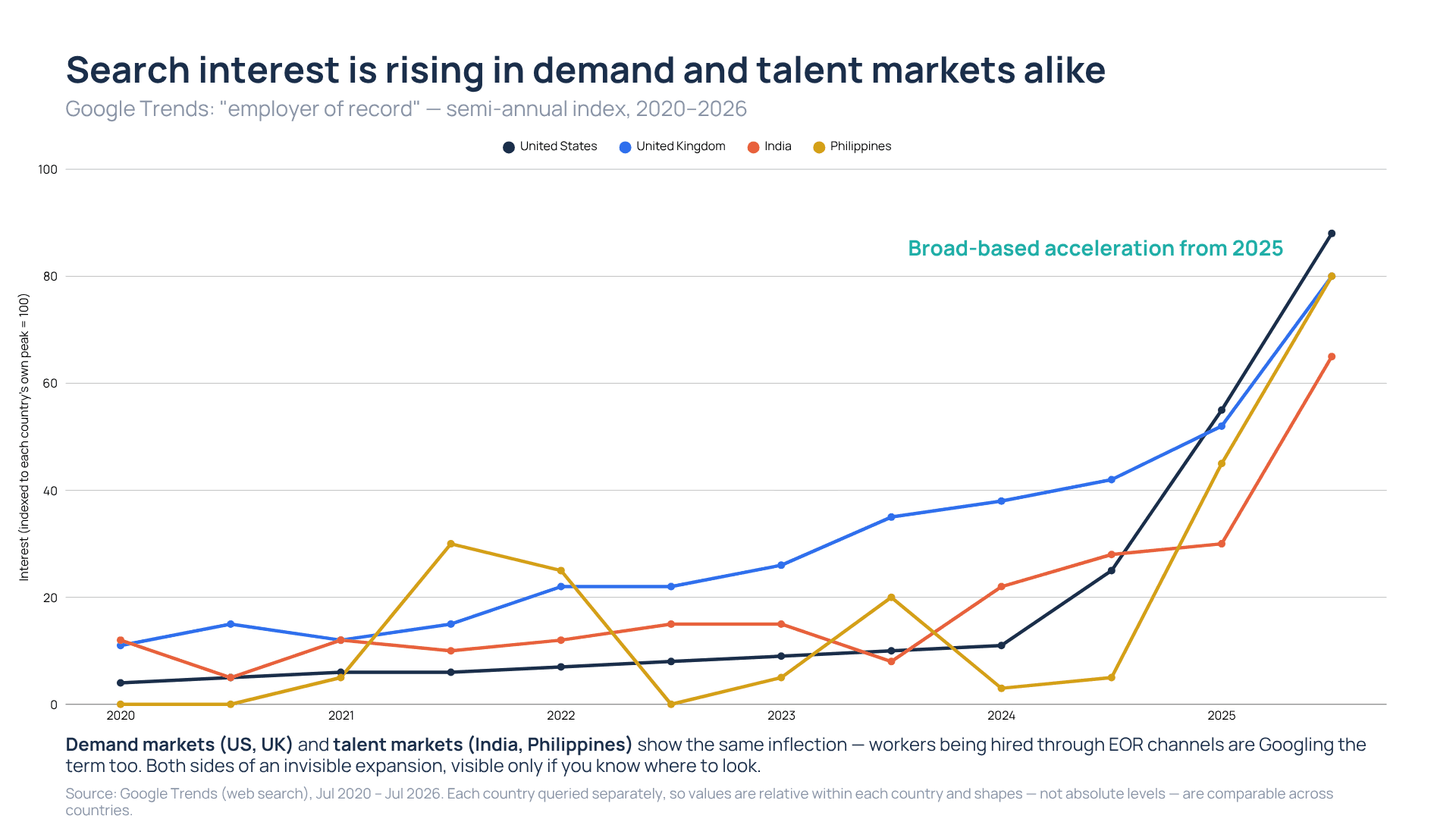
You can even see the shift in aggregate search behavior. Interest in the term "employer of record" has climbed steadily since 2020–21 and keeps accelerating — with strong interest not only in hiring markets like the US and UK, but in talent markets like the Philippines and India, where the workers being hired through these arrangements are googling what an EOR actually is. Both sides of an invisible expansion, visible only if you know where to look.
For companies selling into expanding businesses, for consultancies advising on market entry, and above all for the agencies whose mandate is to attract investment, the conclusion is clear: the registry is no longer where expansion begins. It's where expansion is announced, long after the interesting decisions have been made.
The winners in this new environment won't be the ones with the best registry monitoring. They'll be the ones who learned to see the pre-entity phase.